Thursday, 17 December 2015

BBSAC Xmas do - 16th December 2015

25 of us gathered at the community-owned Ivy House in Nunhead for this year's xmas do. Clive and Sally provided amusing hats for everyone. The Ivy House dealt with our large group very well.

Pat the Chair presented Sally with the Barry Maisey Award for her hard work this year, which included putting together the club's grant funding application, doing the Instructor Foundation Course, delivering a lot of training (at the pool, lakes and at the Swanage training weekend), promoting the club and initiating try-dives via Facebook, postering and promoting in connection with the This Girl Can campaign, helping with legal queries, and generally being of assistance (and noticing when assistance is needed) on Wednesday evenings especially. On top of all this, she recently qualified as Dive Leader, which is also beneficial to the club. Well done, Sally. 

Sunday, 13 December 2015

Silfra dive, Iceland - 7th November 2015

by Victor

This was a dive I’d been wanting to do for a long time, and I finally got the chance during a six-day trip to Iceland in November. I dived with dive.is who seemed like a decent outfit, although Scuba Iceland (scuba.is) also look like they might be worth a try. Two dives with dive.is cost 39,990ISK (about £204 – yep, Iceland is still expensive). This includes equipment, hot chocolate and biscuits between the dives, and pick-up/drop-off from/to your accommodation in Reykjavik. Today we were collected at a very civilised 10am, and dropped off at 4.30pm. The dives were led by Rachael, an instructor from Northern Ireland. Other dive.is staff helped out during kitting-up, and took a group of snorkelers into Silfra just before us five divers got into the water. The drive from Reykjavik takes about 45 minutes, and we experienced some dramatic weather (including rainbows) on the way. Entry into the water is via a short walk, and a platform and steps fixed to the rock.


There’s not much I can add to the huge amounts of online information and the many recent magazine articles about Silfra, other than to confirm these two dives definitely lived up to the hype. The water is unbelievably clear (visibility of well over 50 metres, probably a lot more), and yes – to repeat the cliché made over and over online – diving these waters felt like flying. In such good visibility, the variety and intensity of the blues in the water was incredible. The near-silence underwater was also notable, and differed greatly to the relatively noisy UK sea waters we normally dive in. Silfra is full of glacial meltwater, and apparently safe to drink – it was fun to take out our regulators for a sip. The dives lasted 33 and 32 minutes, and involved a gentle drift down the fissure, passing through wide and narrow spaces, always with unobstructed access to the surface. There is a point in the dive where you can pause with each hand on the rocks to your left and right, however Rachael explained that it’s not quite correct to say (as some guides do) that one rock is the edge of Europe and the other is part of North America – both sides of the fissure are within the rift valley which is a no-man’s-land, not part of either continent. We saw no wildlife other than a few bright green weeds, however trout apparently live in the lake fed by Silfra. Maximum depth on both dives was 14 metres. The water – at 2 degrees C – was the coldest I’ve ever dived in, but the equipment we were provided with (Bares neoprene drysuit in decent condition, undersuit, hood and thick 3-fingered mitts) was adequate – only my hands and face got really cold. My dive computer, however, decided it was too cold to function, and my camera battery – although almost fully charged – started running low at the start of the second dive. A bathroom at the car park has hot running water, thankfully.

Silfra instantly entered my top 10 favourite dives. I would do these dives again, without hesitation. Snorkelling here would also be worth doing, as you don’t need to be underwater to appreciate the excellent visibility.


Wednesday, 18 November 2015

Bermondsey BSAC committee meeting - 2nd November 2015

Bermondsey BSAC committee meeting, 02/11/2015
Venue: Victor’s
In attendance: Pat, Clive, Lee, Teresa, Ken, Victor
Apologies: Chris, Ross, Colin

Grant funding
  • This is progressing. Ken to provide last bit of information so Sally can submit application.

Xmas do
  • The Ivy House has been booked for 16/12/2015. Victor is collecting deposits. Venue needs menu choices 2 weeks in advance (so by 02/12/2015). We’d prefer 1 large table together. We won’t know which room we’re in until we know numbers. If the room is unsuitable for announcements etc, Barry Maisey award and other awards could be given out at the AGM instead – this is to be decided once we know numbers. 

Training and post-training dives/activity
  • 2 students have recently begun Ocean Diver training (OS2 will be completed this week, with a lecture the following week), and various people are part way through their Sports Diver and Dive Leader training. Some have almost completed. Those who haven’t been seen for a while need to be contacted.
  • Several members became Ocean Diver qualified this year. The club now needs to encourage and facilitate diving for these members – Red Sea and Nemo 33 trips may be suitable, and the Sports Diver course can commence in the new year.
  • Various ideas for keeping newly-qualified members engaged over the next few weeks were discussed. These included starting Sports Diver lectures over winter, sessions at Seven Islands (DSMB use, navigation, lifting bag deployment, ditch and retrieve, CPR, buoyancy practice with hoops, search and recovery etc), asking newer members to speak with newcomers and/or assist with a specific task, and volunteering as casualties for pool lesson SS1.
  • Mentoring of members who complete the Instructor Foundation Course was also suggested.

2016 dives
  • 10 people are now on the Red Sea trip, plus a friend of Sally and Clive’s. Spaces are still available.
  • No club kit shall be leant for the Red Sea trip.
  • Noted that the club is not liable for non-members on the Red Sea trip.
  • Pat to forward liveaboard bringlist to Teresa for circulation – this would be useful to newer members.
  • DSMB and rescue skills session in the pool would be useful for Red Sea trip attendees. Testing of kit early (before departure) shall also be encouraged.
  • Mevagissey (Scubafest) boats will be booked once announcements are made by organisers – this will probably be in the new year.
  • A trip to Nemo 33 may be added to the 2016 dive list – to be confirmed.
  • Renting a van or minibus for the Scapa trip was discussed. Daniel is willing to do some of the driving. A 2-day drive (stopping overnight in somewhere like Aviemore) means more than 2 drivers will probably be needed.

2017 dives
  • Ken suggested fixing a date (early, before the 2017 dive calendar fills up) for a shore-based trip, intended to facilitate diving for newly-qualified members.
  • Ken also suggested a trip to Scotland – St Kilda, Shetlands or Mull.

Website
  • Some recent blog entries have been posted.
  • Ken needs 2 solid days to work on the new website.

Snorkel members
  • As agreed over email (after the last committee meeting), a “Snorkelling Member” will be charged £26 per annum (or £2.50 per month) in club/pool fees, in addition to the £18.50 annual BSAC membership.
  • Once the current Snorkel Diver cohort have completed their course, they would be able to continue snorkel practice in the pool. Emily can be offered a try-dive. Snorkelling trips to Kimmeridge Bay or Swanage are likely to only happen as part of a dive trip to those locations.
  • No new snorkel training courses will be commenced this year.
  • Interest in the Advanced Snorkeler course has been expressed by 1 member.
  • Noted that Open Water Instructors can sign off the Advanced Snorkeler course.

Falmouth fills
  • Progress on this matter was discussed.

Socials
  • Teresa noted the folk night at the Ivy House was cancelled, and suggested an India-themed event at the Victoria and Albert Museum on 27/11/2015.
  • Socials were needed in November and January. Previous suggestions were recalled.

60th anniversary
  • 02 or 16/07/2016 were possibilities for the anniversary barbeque/gathering. 02/07/2016 to be suggested to Ross.
  • Victor to speak with Dave and Ed about contacting past members.
  • Teresa to liaise with Alex regarding food.

Club kit
  • In the light of today’s update from Ross, means of keeping track of club kit were discussed. Submission of BSAC membership cards (as a deposit) was suggested, but committee preferred (and agreed) that – in future – club kit (including cylinders) will not be issued directly to students, but will instead be handed to instructors who will be responsible for that kit, and for its return after the dive.
  • Call for return of club kit to be included in next weekly email.

Barry Maisey award
  • A nomination for [to be revealed at xmas do] was made and agreed.

Next meeting and Annual General Meeting
  • AGM to be held on Wednesday 03/02/2016, 8pm.
  • Next committee meeting to be held on Thursday 14/01/2016, 8pm. Committee nominations will then be invited via email the following day, with 25/01/2016 being the deadline for nominations.


Wednesday, 4 November 2015

Stoney Cove - 18th October 2015

Sally and Geraint went to Stoney Cove for this month's lake trip with Lee and Clive, where Sports Diver (update) and Dive Leader training was delivered. Resusci Anne made an appearance, and Sally finished off her Dive Leader practical skills.


Friday, 30 October 2015

Gozo - 10th-17th October 2015

by Jane

Four of us (Chieko, Colin, Jane and Lee) went for a week’s diving in Gozo, the second island of Malta (well Lee was there just until the Wednesday) in mid-October. The weather was warm, and the sea sufficiently so to require only 5mm shorties.

We stayed in a basic B&B in the village/small town of Marsalforn on the north coast of Gozo, and dived with Gozo Aqua Sports. Our dive guide was mostly Matt. Apart from the sea life much of the interest is the fascinating rock formations found under water, creating natural gullies, chimneys, caves and arches.

For most of the week, dives were constrained by which way the wind was blowing, limiting the availability of sites. All the dives were shore dives, and the first was on the south coast at a place called Hondoq, a nice relaxing check dive, no deeper than 13m, mainly over sand and sea grass, most memorable for an excellent view of a small stingray burrowing for prey in the sand. This was followed by a dive which, while of a similar depth, was in a narrow inlet with cliffs either side. It was therefore a sort of wall dive but without the need to maintain a constant awareness of depth, and there were also a couple of small caves to explore.


The following day we were a little more ambitious and dived the top 25m of a pinnacle, with a large number of fish feeding on the algae and other encrustations on the pinnacle with jacks just of the site in the blue. The afternoon was the Inland Sea, one of the classic dives in Gozo. It is formed by the intrusion of the sea through a tunnel, creating a shallow lake which one crosses before submerging and swimming through the tunnel, taking care not to be run over by the boats taking the sightseers out to sea to see the Azure Window.

A wall dive with lots of incrustation and other life is found to the left of the exit, whereas to the right, as our brief foray showed, was much less interesting.

On the Tuesday we lost Matt, and Duncan took us out for the day. The first dive was the usual check out dive site for the centres based in Marsalforn, and which we had been unable to do on the first day because of the wind. Duncan had great pleasure in finding interesting things for us to look at and we had a very leisurely dive for over an hour including octopus, and an unusual scorpion fish generally found in deeper waters. 

Unfortunately I managed to kneel on a fireworm and felt unable to dive that afternoon.  Everyone else went off to Reqqa, another of the more celebrated dives, often with excellent wildlife to see. On the Wednesday Lee left us to make his way back to the UK, journeying back to the airport on the local public transport.

On the Thursday Chieko had a day of rest, and just Colin and myself (with Matt) revisited the Inland Sea, only to find that we couldn’t park, so went to the adjacent site of the Blue Hole which is a dive through a wide chimney, out at the bottom and an exploration of the cave behind, under the Azure Window, round the promontory and back through a very interesting narrow and bendy chimney into the coral garden before exiting on the other side of the Blue Hole, which for me was one of the best dives on this trip. The afternoon was a return trip to Xwenjni Bay by Marsalforn.

On the Friday Chieko managed to forget her booties in the morning, so just Colin and I repeated the Pinnacle dive of a few days earlier. We were accompanied by a German couple, one of whom managed to run out of air, despite Matt regularly checking our consumption, which curtailed the dive a bit. We then tried the neighbouring site in the afternoon, to which Chieko had walked during the morning dive and had found empty. However, by the time we arrived in the afternoon there seemed to be a conspiracy of white cars occupying all the parking spaces, with no sign of any divers! Therefore after a bit of a further drive around because of various problems relating to parking and other access issues the three of us revisited Hondoq, and found the stingray again.


Thursday, 29 October 2015

Coron - 7th-8th October 2015

Travelling all that distance to Taiwan made it worthwhile taking a 2 hour, 20 minute flight to Manila for a week in the Philippines. Travelling down to Coron Town on the island of Busuanga, the plan was to do some dives on the many WWII wrecks in the surrounding waters. I booked these dives with Neptune Dive Centre (http://www.neptunedivecenter.com/). I stayed at Jazmine’s Place (http://www.jazminesplace.com/) which was cheap and OK, but there are probably better accommodation options available.

An early (7.30am) start on the Wednesday began with analysing and labelling our cylinders. Neptune have a good system – the dive leader (Tan, who is brilliant) made sure we had analysed and noted our % O2 and MOD ourselves, and had written these (with our names and dive number) on a yellow and green sticker on each cylinder. Neptune also kept a record of what % O2 we were using. Briefings before each dive were illustrated and very clear – they had to be, as we would be penetrating wrecks. Down at the harbour we boarded a bangka named Kuracha, which had plenty of space and cover, and 6 crew (including dive centre staff) for 5 customers – a ratio I’ve never seen before. There was a constant supply of soft drinks all day, and the boat had a head. I dived with Han and Keli, 2 excellent divers from China, and we were led by Tan. 2 other less experienced divers stayed at shallower depths with another instructor and didn’t enter the wrecks.

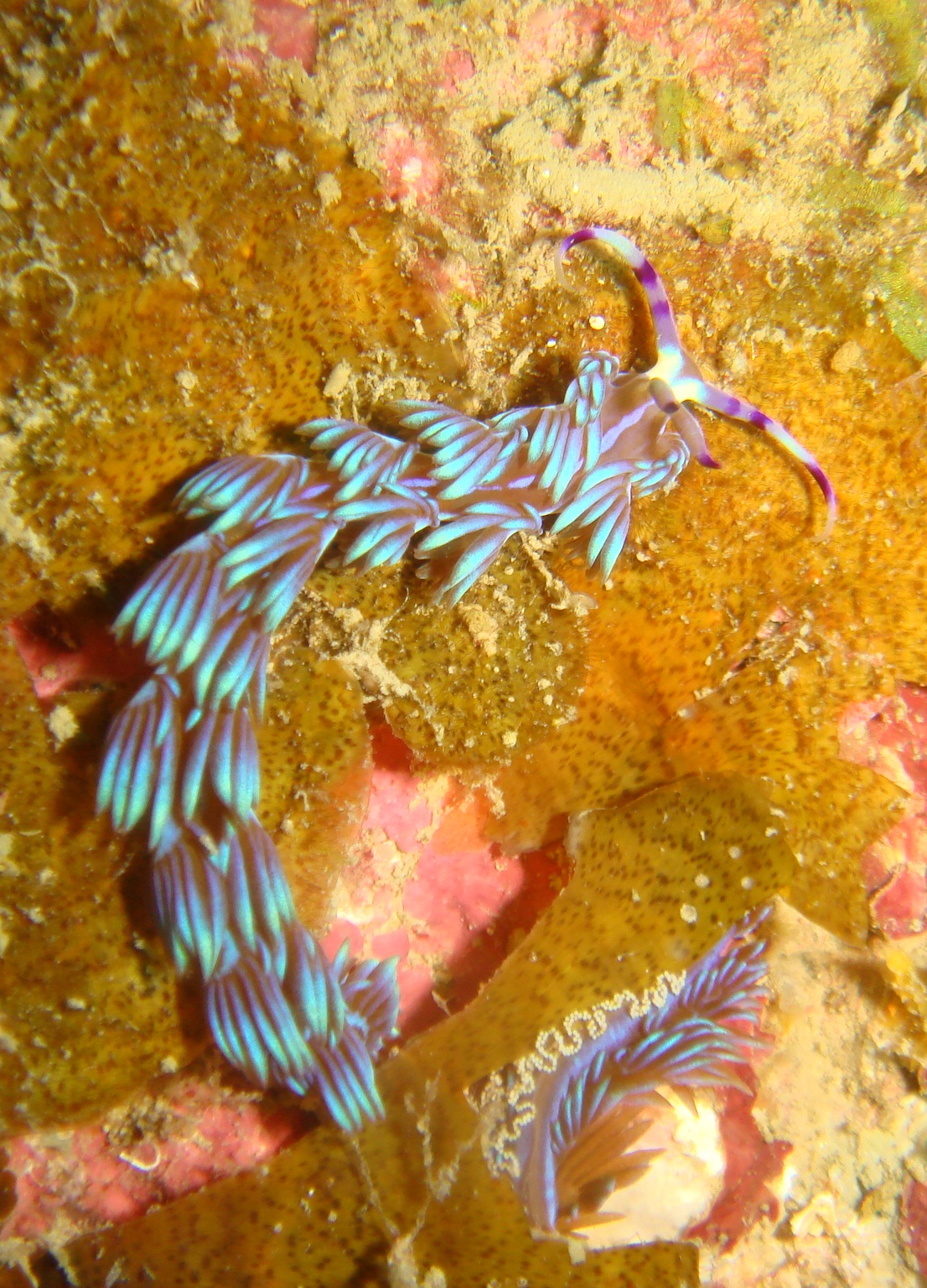
The first dive was the Akitsushima, an Imperial Japanese Navy seaplane tender sunk in 1944. This is some distance to the west of Coron Town. We reached depths of 32.6 metres and dived for 45 minutes, entering the wreck and passing through various parts of the interior. After lunch we dived the Okikawa Maru wreck (a Japanese oil tanker, 168 metres long, with several long purple-and-blue aeolid nudibranchs on the deck) for 56 minutes. We reached 24.7 metres. We finished the day on the Morazan Maru wreck, an English-built cargo and passenger ship where we moved through a couple of fairly narrow holes to see inside tiled shower rooms, cargo holds and other spaces.  We got back to the dive centre at about 6pm. All 3 dives today were great – although I’m not normally mad keen on wrecks (or entering them), these were impressive, relatively intact, supported a decent amount of wildlife, and – inside – were very atmospheric where the outside light entered via portholes and rusty openings. Visibility wasn’t fantastic – no more than 5 metres (I read later that this is due to local agricultural run-off), down to 2 metres inside parts of the wrecks. Other than close-ups, my photos didn’t turn out so good.

On my second and last day of diving I turned down an invitation to dive a wreck on the north side of Busuanga where apparently 20 metre visibility is guaranteed. The cost, early start, and jeepney journey across the island didn’t seem worth it for 2 dives. Instead I did another 3-dive daytrip on the south side of Busuanga, this time from the boat Dhel, a smaller (but big enough) bangka which took us to the Olympia Maru wreck. Unfortunately, although I had understood we would be diving on air today, nitrox was brought out to the boat, and yesterday’s analysing and labelling of cylinders wasn’t repeated due to there being a bit of a rush at the dive centre in the morning. I hadn’t analysed the gas myself, I wasn’t certain that the “36%” written on masking tape on my cylinder was accurate, and there was no analyser on the boat, so I proceeded with caution, and – with the agreement of the other diver who also had concerns about depth and penetration – stayed at depths shallower than the MOD for 36% O2. This meant we did not enter any wrecks today, which was fine, as there was plenty to see on the outside, including bat fish and many lion fish.

We then had the best lunch I have ever had on a dive boat – an amazing sweet potato curry cooked on board by the skipper.

The second dive of the day was on the wreck of the Kogyo Maru, a large supply vessel lying on its side. Of course, on the day that my camera battery had run out, photogenic wildlife was out in force, including 2 fat nudibranchs with purple, white and yellow bodies in a well-lit, accessible location with little current. Lion fish and scorpion fish were also seen. It was on the third dive of the day, however, that I really regretted not having a useable camera – on the “Coral Garden” drift dive along the southwest side of Lusong Island we saw a huge variety of coral, and at least 4 different species of nudibranch, in a variety of colours and shapes. Brilliant dive.

These 6 dives were very good, Tan was a particularly good dive leader, my rented dive kit was decent enough, the weather was fine, and water temperatures (mostly 29 degrees, up to 33 at the surface) were lovely. The dives plus kit hire and lunches cost me 9,000 pesos (£126). I’d come here again, and would dive with Neptune again, although a liveaboard may be a good idea, so we could access the further-out wrecks/reefs where visibility is apparently better. A dive on the Irako wreck, and dives on reefs where sharks have been seen, would also be good.


Taiwan - 26th September - 1st October 2015

Taiwan might not be an obvious choice for a dive holiday for Europeans, given what other dive destinations exist a similar distance away, but a little research confirmed it was worth travelling to the south of the island (after a brilliant 5-day mountain trek in the north) for some warm, colourful dives south of the Tropic of Cancer. We booked 6 days of diving with Sheffield expat Andy Gray (www.taiwandive.com), who operates through Dive Pro (www.divepro.tw) in Houbihu in the Kenting National Park. We stayed in Dive Pro’s accommodation (basic, clean en-suite single rooms with AC and TV, but they also have a dorm) above the dive shop.


On our first day of diving we drove in the back of a pick-up truck the short distance to the harbour and boarded the Nanjing, a dive boat with plenty of space and cover. Andy was amiable and had the right attitude towards wildlife conservation. Dive Pro staff kindly did most of the shifting of kit for us, and cold water and snacks were available. After that good start, things didn’t go so well – there was no safety briefing before the dive, Andy drifted off at the start of the dive before we had completed our weight checks, and to join him we had to surface swim a considerable distance (without SMBs or our flagged boat nearby) across water being used for jetskiing and inflatable banana boat rides. Gareth from our group had trouble descending, and after Daniel rejoined him on the surface, they were picked up by another boat. It was only 20 minutes into the dive that I was asked where 2 of our group had gone.

Needless to say, words were had before the next dive, and although we still weren’t entirely convinced we were diving safely, the 4 other dives we did with Andy passed without incident, however after 1 dive there was a long wait for a pick-up, due to our boat attending to a group of freedivers some distance away. All these dives were from the Nanjing, and were scenic dives over corals and interesting rock formations. I don’t think I’ve seen such a wide variety of different types of coral on a single dive before. Moray eels, lion fish, clown fish and other critters were also seen. Visibility was good to excellent – up to 20 metres. Waters were 27 to 29 degrees.

Day 4 was blown out due to Typhoon Dujuan (aka Typhoon Jenny in the Philippines). Although we avoided the worst of the cyclone (it passed over the north part of Taiwan), it made the waters in the south too choppy to dive.

Andy was not available for the rest of the week, and we did our remaining 4 dives with Dive Pro’s Taiwanese staff (Mike, Rudy, Olga and others), who gave us illustrated briefings, and who were very good at pointing out features and creatures during the dives, including a tiny thing that resembled a scrap of seaweed (possibly a sargassum fish), 2 nudibranchs and many barracuda. These were all shore dives, one known locally as the “outlet”, where water used for cooling the nearby nuclear reactor is pumped out, resulting in visible thermoclines where the 30 degree water met the cooler (as low as 25 degree) sea water. The other dive site was the “feeding area”, so-called because many of the dive guides operating in the area unfortunately bring bread to attract fish with.
 

9 dives, 7 nights in a single room, kit hire and 3 lunches cost me NT$27,430 (about £553). Eating options in Houbihu are limited but not bad, and on some evenings we took a 20-minute taxi ride to Kenting Main Street, which is brilliantly hectic and brash, and worth a look. If you get blown out, there is the nuclear power station visitors’ centre and local fish market to visit, otherwise the massive Museum of Marine Biology (out of town – get there by taxi or bus) is recommended.